BOOK
The Book
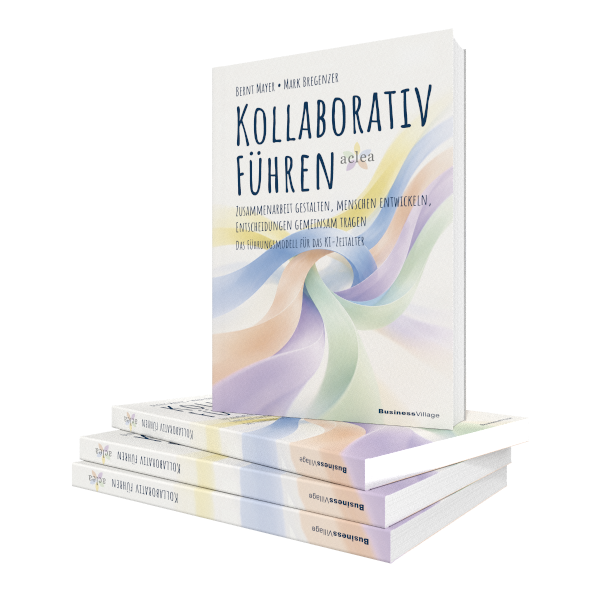
Kollaborativ führen. Zusammenarbeit gestalten, Menschen entwickeln, Entscheidungen gemeinsam tragen.
Mark Bregenzer · Prof. Dr. phil. Bernt Mayer
GERMAN EDITION, MARCH 2027, BUSINESSVILLAGEThe book will initially be published in German. An English edition may follow at a later stage.
THE BOOK
Why we are writing this book
More and more organizations come under pressure in agile and digital transformations. Not because they lack methods, but because they are not used to making decisions jointly and at eye level. For decades we have learned: leaders decide. In manageable environments, that works. In complex ones, it repeatedly leads to suboptimal decisions, because the knowledge of many remains untapped.
Self-organization is meant to counteract this and makes the decision-making process richer. But because collaborative decision-making is unpracticed, it easily tips into the opposite: options are talked to death, or the loudest voice pushes through their own interest. That, too, does not lead to truly good decisions. On top of this: self-organization depends on engaged employees, and that is precisely what is missing in many places, as the Gallup studies show year after year.
This is exactly where this book comes in. We want to enable organizations to decide collaboratively, well and quickly, and at the same time lead more people into self-motivation. In our view, a book that combines both does not yet exist.
The result is Applied Collaborative Leadership: a systemic leadership approach with ten principles in five focus areas that shows how organizations turn the knowledge of many into good decisions. It draws on decades of experience in organizations, transformations and HR work as well as on the scientific grounding in business psychology and leadership research.
The challenges are great: global competition, global crises, and an AI that will profoundly change the world of work and society; exactly how, nobody knows. What companies need then is not the pursuit of stability, but the ability to deal with change well and effectively.
The book will be published in German by BusinessVillage in March 2027. Until then, the newsletter reports on progress, and the community offers a place to explore the topic in the meantime.
What the book is about
The more complex the tasks, the more vital collaboration becomes. In practice, however, goal systems reward individual performance, decisions get stuck in rounds of alignment, and top talent sometimes gives up its expertise to advance a career. And where AI systems help shape decisions, it remains unclear who bears responsibility.
This raises three questions for leaders: How do I create conditions under which collaboration becomes the obvious way to work? How do I integrate AI into leadership and decisions without diluting responsibility? And how do I recognize early whether my leadership approach is taking effect?
The new book by Bernt Mayer and Mark Bregenzer shows that collaboration rarely fails because of the participants' willingness, but because of structures that reward something else.
With aclea, the authors present a scientifically grounded leadership model that brings together what is usually treated separately: decisions, strategy and organization, careers and compensation. Ten principles in five focus areas form the core, including equal advancement opportunities for specialists and leaders. Field-tested instruments, such as the Team Knowledge Model, make it applicable. AI is considered wherever it touches leadership.
A step-by-step development journey anchors the model in the organization, without a rigid rollout. Signals show whether it works, long before the numbers reveal it. A book for decision-makers who want to enable collaboration rather than demand it.
Planned contents
A look at the planned structure of the German edition, subject to change:
- 01Introduction
- 02Part I: The Foundations of aclea
- 03Part II: The Practice of aclea
- 04Part III: Anchoring aclea in Organizations
- 05Part IV: Further Perspectives
- 06Closing Remarks
- 07Appendix
What the book is about is shown at a glance on the model page.