Rotating is still just delegating
Why the most popular team answer to unplanned work preserves the problem.
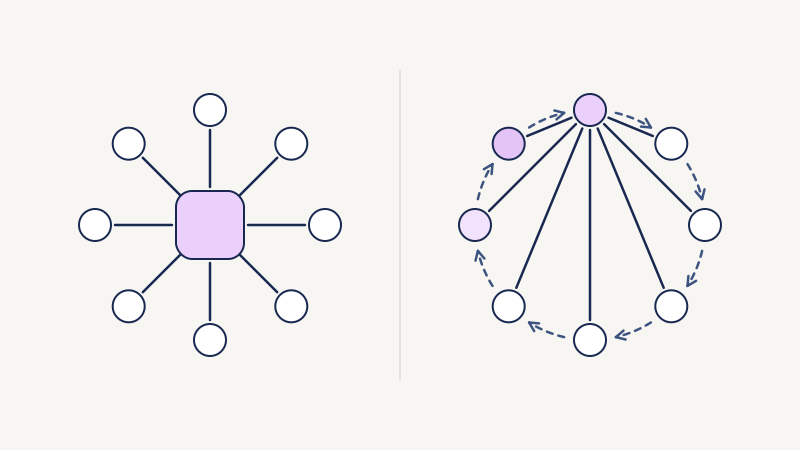
A product unit, around seventy people, eight teams, one shared product. In the retrospective, the topic comes up that has reached every retrospective there for months: unplanned work. Service requests, defects, questions from operations. They show up whenever they like, they cannot sensibly be written into a sprint backlog, and they pull people out of the work they are in the middle of. The complaint is justified. Context switches are expensive, and nobody likes working to a rhythm they cannot influence.
Then comes the proposal. It comes almost always, in almost every organization, and it comes in three stages.
The first: we name someone to take care of it. One person reviews everything that comes in, prepares it, and passes it on so the others can work undisturbed.
The second, usually put forward by those who already have agile experience: not like that, that is too close to management. We rotate. This sprint it is Peter, next sprint Julia, then Heiner.
The third, in a multi-team environment: individual responsibility is supposed to be a thing of the past, we are jointly responsible as teams. So each sprint one team takes on the unplanned work for everyone. The other seven work on the backlog in peace.
Three proposals, one single movement
The three variants feel progressively more advanced. Structurally they are identical. In all three, an instance is appointed to take care of things, and everyone else switches to hands-off mode and relies on the instance to do its job. The only difference is who this instance is and how long it stays that way.
That is delegation. In variants two and three it wears a fairness costume because the burden goes around, but that changes nothing about the pattern of responsibility. The very pattern most transformations want to leave behind is reintroduced here. Voluntarily. By the team itself. In a retrospective.
That it is so tempting has a good reason: it is a correct answer to a real pain. Whoever says "constant ticket handling pulls me out, that is bad" is right. Only the conclusion drawn from it, to do it less often, reaches for the wrong lever. And it has a price that nobody has on their list in that moment.
Why rotation in particular is the most expensive
Run the numbers on the case. Eight teams, two-week sprints, rotation across sprints: whoever is on duty this sprint is off duty for the next seven, that is roughly fourteen weeks out of contact with this work. Fourteen weeks is long enough to forget a process.
The real damage, however, is not the forgetting but the improvement that never happens. Once the rotation is in place, no team has a real interest in actually fixing the obviously clumsy process. Two weeks can be endured. You grit your teeth, then you are out again for a long time, and the annoyance vanishes from your head before it could turn into an improvement. The pain is spread so thinly across the organization that nobody feels it long enough to fix it.
And even if one team does improve something: the other seven know nothing about it. They return weeks later and carry on with the old state, because they never saw the new one. Improvements evaporate not out of malice but out of structure. That is what makes the process truly hard to change. Rotation, then, does not organize responsibility. It organizes forgetting.
A side effect comes on top, one social psychology has described for decades. Latané, Williams and Harkins (1979) showed that individual effort drops as soon as contributions blur into a collective, and that it returns as soon as one's own contribution becomes recognizable again. A responsibility that collectively lies "somewhere with the on-call team" is exactly this blurring.
The reflex that runs exactly the wrong way here
Agile practice knows a rule of thumb that sounds so illogical you remember it: if it hurts, do it more often. Martin Fowler (2011) spelled it out. The most painful activities in software development, integration above all, do not get better by being postponed but by being done more frequently. Fowler names three reasons: you have to break the thing into smaller pieces, you get feedback faster, and you get better through practice.
Rotation turns all three into their opposite. It does not break down, it bundles into larger packages. It does not shorten the feedback loop, it stretches it to months. And it does not distribute the practice, it concentrates it on whoever is on duty and lets it lapse for everyone else.
Put differently: the teams do the painful thing less often and in bigger portions. That is exactly the batch enlargement that is laboriously trained away at every other point in the value stream.
The less comfortable but sustainable answer
The way out begins with a different question. Not: who takes care of it? But: when does the next moment arise in which someone can take care of it without being pulled out?
When teams cut their work so that individual tasks can be completed in two or three hours, natural touchdown points arise several times a day. Whoever finishes a task looks at the list of open requests before pulling the next planned task, takes an item and writes their name on it so everyone can see it is being handled. Nobody is interrupted, because the moment is a transition anyway. And nobody has to oversee the whole list; everyone only ever sees the small slice they are pulling right now.
The second part is the more important one. Taking care of something does not mean solving it yourself. It means making sure it gets solved. Whoever pulls the item and finds that the competence lies elsewhere looks for the person who can do it and coordinates with them. That is not a makeshift solution, that is the core. Taking responsibility and owning the work are two different things, and mixing the two up is the reason so many people shy away from touching anything at all.
And here something opens up that cannot even occur in the logic of delegation. The conversation with the knowledgeable person has more than one possible outcome. They can take over, that is the simple case. But they can also say: this is a small thing, let me show you. Or: I have no time right now, but in two hours we sit down together and do it jointly. An item that a moment ago was a disturbance then becomes a learning opportunity, and the most valuable kind: learning on the real case, with someone next to you who can do it. Working your way alone into an unfamiliar field is tedious and often hopeless. Precisely these handover moments are the points at which knowledge actually travels in an organization.
So that this does not become an obligation, the opposite direction is explicitly part of it. It is perfectly fine to say: this is not on my learning path right now, I will make sure it lands with the right person. Nobody has to want to learn everything. But because both paths are open, every single case decides anew whether this item is merely completed or at the same time used to build capability. Nobody makes that decision at the drawing board; it arises in the moment and out of the matter itself. That is a piece of collective intelligence: many people judging in the concrete context instead of following a rule that was fixed beforehand for all cases.
What does need to be settled up front is the question of priority. Not every request is urgent, and commitments to users can be agreed instead of renegotiated in the moment of interruption. Whoever has decided that together once does not have to decide it again every time.
And that is where the actual reversal lies. Most organizations try to manage their working day: plan first, then execute, and everything that interferes counts as a disturbance. Here it runs the other way round. The available capacity follows what is actually pending. For many, that is the most unfamiliar part of the whole idea.
Why this is not just a question of process
What is at stake here is not the efficiency of a ticket list. It is the question of whether responsibility in an organization is carried jointly or merely administered neatly.
Collaborative leadership starts here with structure first, not with attitude. A process in which someone takes care of things several times a day and remains visible in doing so makes self-efficacy tangible: I can act, I see the effect, my contribution is recognizable. A process in which everyone stays in contact with the same work is what makes continuous learning possible at all, because an improvement is then something many people understand and carry forward at the same time. And the decision on how to deal with unplanned work becomes what it should be: a jointly carried decision about one's own product, not a duty roster.
One question remains open, and it is the more uncomfortable one. The rotation proposal did not come from above. It came from the team, well intended, in a format meant to serve improvement. So how does an organization recognize that a proposal of its own devising will not take it where it wants to go? That is the subject of the article "Many ideas are not yet an intelligent solution".
The receiver's side of leadership is one of the building blocks of our book "Angewandte Kollaborative Führung" (Applied Collaborative Leadership), which is currently in the making. If you do not want to miss the publication:
Subscribe to the newsletter- Fowler, M. (2011): Frequency Reduces Difficulty. martinfowler.com, July 28, 2011.
- Humble, J. & Farley, D. (2010): Continuous Delivery. Addison-Wesley.
- Latané, B., Williams, K. & Harkins, S. (1979): Many Hands Make Light the Work. The Causes and Consequences of Social Loafing. Journal of Personality and Social Psychology 37(6), 822-832.