Many ideas are not yet an intelligent solution
Why smart teams so reliably arrive at obvious, correct, and yet problematic solutions.
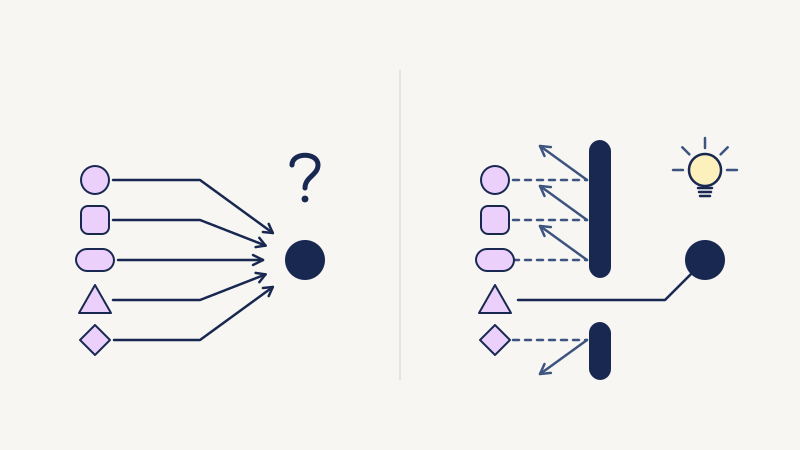
Minute forty of a retrospective. Eight teams work here on one shared product, and on the table lies the topic that has kept coming back for months: unplanned work. Service requests, bug reports, questions from operations. Things nobody planned for and that come in every day regardless.
A proposal is in the room. Each sprint, one team takes on the unplanned work for all the others. The remaining seven work in peace on what they set out to do. The proposal comes from the teams themselves. It is fair, it takes turns, nobody is favored.
Nods go around the table. At the head of the table sit two managers. They say nothing. The proposal is adopted.
Everything about this process was right. A team identified a problem and wants to solve it together. It brought the problem into the format that exists precisely for this. Everyone thought along. They reached agreement and will implement it. And yet the decision leads the organization straight back to where it actually wanted to get away from.
Why this particular solution is so expensive, I described in the article "Rotating is still just delegating". This one is about the level above. About two questions: why does a room full of smart people so reliably arrive at suboptimal solutions? And how could anyone in the room have noticed that this proposal was not fit for purpose?
A preliminary remark that brings the case into focus. What actually bothers the teams is not the unplanned work as such. It is being torn out of what they are working on right now. And that is exactly what they have been trained against: within a sprint, a team is supposed to be able to work undisturbed. Measured against what everyone in the room has learned, the proposal is not merely obvious. It is correct.
Why the quick solution displaces the right one
There is a good answer to the first question, and it has nothing to do with a lack of intelligence.
In the moment the unplanned work lands on the table, two paths are open. One is quick and takes effect immediately: set up a responsibility that catches the stream. The other is slow and uncomfortable. It begins with the question of why this work arises in this quantity at all, and how the organization could carry it without handing it off.
Organizations almost always choose the first path. Peter Senge described this pattern as Shifting the Burden, and its core is uncomfortably simple: the quick solution takes the pressure off the actual question. The uncomfortable question does not leave the table because of it. It reads: why do we work in a way that lets unplanned work tear us out of context like this? The quick solution simply ensures it never becomes urgent and painful enough to be worked on.
With every repetition, the dependence on the responsibility grows. And the ability to work together on the root of the problem withers, because it has not been used for a long time. In the end, the organization can no longer do anything but name a responsibility.
The bitter part: everyone in the room decided reasonably within their own time horizon. The damage does not arise from one wrong decision, but from a chain of right ones.
How could anyone have noticed?
That leaves the second question, and it is the more interesting one. What would have had to be different in this room for the proposal to stand out as unsuitable?
It was not for lack of ideas. Several variants were on the table in the retrospective: one person, a rotation, a whole team. Most teams can muster attention for a problem, and when enough people sit together, plenty of proposals emerge as well. Both are necessary. Neither is hard.
What was missing was something else: a yardstick. It acts like a filter on solutions. Proposals that do not fit what this organization has set out for its future way of working do not get through in the first place.
This is exactly where swarm intelligence parts ways with collective intelligence. A swarm follows simple rules that are the same for everyone and that anyone can follow. For the individual bird, that raises the chance of survival without it needing to know anything about the whole. Such rules are not wrong; they even work measurably. During the pandemic, distancing and hygiene lowered infection numbers without anyone needing to understand virology for it. Yet they could not solve the actual problem. That took a vaccine, and for that, knowledge from many disciplines, brought together into something that would never have emerged from a simple rule.
Note: I am aware that the Covid pandemic and the response to it are controversially discussed. I do not want to pass judgment here, but to show the mechanics between following rules and finding intelligent solutions.
The retrospective, too, is a simple rule: recognize problems, find solutions, improve. The room followed it, and followed it correctly. What the rule does not answer is whether the solution found holds in the long run and leads in the direction the organization has set for itself. That takes collective intelligence.
In the retrospective it went exactly like that, and the decisive thing is: the proposal really does solve the problem. Whoever is not on duty works undisturbed. Everyone in the room checked that and rightly concluded that it fits. Agreement in the round was even unanimous. But the yardstick was only to fix the local problem quickly and efficiently. The system effects at a higher level were not checked.
And one level up, the proposal hands the jointly carried responsibility for the product to one team per sprint. Precisely the division the organization wanted to move away from.
So this is not about finding a solution quickly. There are always many solutions. That is precisely the difference Peter Kruse sharpened early on: the source of intelligent decisions is not marching in step, but difference made productive.
For that, however, someone has to ask the question about the overall context.
Without a commonly known yardstick, every retrospective therefore often remains a retrieval of familiar patterns. And the most familiar patterns are the ones applied the longest. That is why people in change processes fall back so readily into old patterns. Here it was the pattern of central coordination: a responsibility, a role, a handover, a status report. These patterns are not available because they are good, but because they are familiar. And repeating patterns (best practices) without reflected adaptation to context reduces people to swarm behavior.
How a yardstick works
Richard Rumelt, in his work on strategy, calls such a yardstick a guiding policy. For him it sits between the diagnosis of a problem and the concrete actions, and the guiding policy is explicitly not an action. It sets a direction and thereby rules out entire classes of solutions before anyone talks about individual ones.
That sounds abstract, but it is not. In our retrospective, it would have sufficed if someone had spoken one sentence that everyone in the room already knew:
We have committed to carrying responsibility for our product together. A proposal that hands part of this responsibility to a single point of accountability is out of the question for us.
That is all it is. A sentence that does not say what to do, but what is no longer an option. The rotation proposal fails on this sentence. Not because someone banned it, but because it fails the yardstick. It works measurably against the goal, not merely against the taste of individuals.
And that is how you recognize a good yardstick: it does not let renaming through. Had someone put the same proposal on the table as a "service guild", it would have slipped past a soft guideline without trouble. Not past this one, because the question stays the same: is anyone handing off responsibility? If a proposal passes even though it carries the old pattern under a new name, it is not the team that thought too little. Then the guideline was worded too softly.
This is not a team task but leadership work, and it is uncomfortable, because a precise yardstick always costs options one would have liked to keep. In a collaborative model, leadership does not deliver solutions, because the people doing the work know the context better. It makes sure the organization is able to judge at all. Principles are not wall decoration for this. They are the reason many ideas turn into one intelligent one.
What happens when the obvious solution falls away
Suppose the objection comes and the quick solution is rejected. A silence settles over the room that feels uncomfortable. What comes next goes in one of two directions. Both are good news.
Sometimes the team does find something after all. An idea nobody had voiced before, because the obvious solution was there faster. Someone tells how they solved this in an earlier team. A competence that has long been sitting in the room and was simply never called upon for this problem. Then the organization lifts a previously unused potential. In that moment, change becomes tangible for the first time: we are doing this differently here now.
And sometimes nothing comes. Then a blank sheet lies on the table and nobody knows how to go on. That is the point at which most transformations turn back. The yardstick is declared too strict, softened, and everyone is back at the start.
If the guideline holds instead, the way back stays closed and only one direction remains: the organization starts to search actively. It researches. It asks people with different experience. It looks to where others have solved the same problem differently. AI, too, can help here, opening access to knowledge and making unfamiliar perspectives visible in the first place. Only here of all places is caution called for: AI systems are predominantly trained on familiar patterns and therefore preferentially suggest exactly what is already widespread. Their answers, too, belong in front of the yardstick. And at some point the organization acquires something that did not exist in it before: a method, a practice, a way of working.
These two paths are not the same thing at two speeds. The first shows that an organization is finally using its full potential. The second shows that it is growing, because it is expanding its room for action. To me, that is real transformation.
The silence of leadership
And with that, back to the two managers at the head of the table who said nothing during the whole scene.
They had agreed to the target picture when the transformation was set up. They knew the yardstick. They just did not speak it when it mattered. Perhaps because the proposal came from the team and one does not want to hold a team back. Perhaps because the silence afterwards would have become uncomfortable, because they themselves perhaps did not see a better solution either.
Often, however, the case is different, and the difference matters. If an organization knows its yardstick and does not act on it, that is a leadership issue in precisely this room. If, on the other hand, it has never formulated one, it cannot judge at all whether a solution holds. Then the work lies not in the retrospective, but before it. Both feel the same in the situation. What needs to happen next differs completely.
This is exactly where leadership is needed once more. Not to deliver the solution, but to prevent the organization from making things too easy for itself. When the reflex sets in to declare the yardstick too strict, it is management's job to say: not that easily. We set ourselves these goals, so we keep searching. This demand has to be insisted upon, otherwise no yardstick lasts long. How to arrive at a good yardstick, a sustainable guiding policy, I will take up in an article of its own.
Whoever decides by consent already has a procedure for exactly this moment. There, after a proposal, objections are explicitly asked for, and the objection is not a matter of taste. It reads: this proposal violates what we have committed to. That makes dissent legitimate. And, more importantly, it makes silence into agreement. Whoever knows the yardstick and says nothing has taken part in the decision.
The most useful effect, however, comes earlier. When everyone knows that exactly this question will be asked, each person checks their idea against the yardstick themselves beforehand. The filter moves forward from the decision round, and over time some of the unsuitable proposals no longer reach the table at all.
The two at the head of the table did not watch. They decided.
A question to take with you: if a proposal lands on the table in one of your retrospectives tomorrow, how would your team recognize that it does not fit you?
The receiver's side of leadership is one of the building blocks of our book "Angewandte Kollaborative Führung" (Applied Collaborative Leadership), which is currently in the making. If you do not want to miss the publication:
Subscribe to the newsletter- Senge, P. M. (1990): The Fifth Discipline. The Art and Practice of the Learning Organization. Doubleday. (System archetype „Shifting the Burden“)
- Kruse, P.: Von Schwarmintelligenz zu kollektiver Intelligenz. Video lecture. Systems thinking summarized in: Kruse, P. (2020): next practice. Erfolgreiches Management von Instabilität. 9th ed., GABAL.
- Rumelt, R. P. (2011): Good Strategy, Bad Strategy. The Difference and Why It Matters. Crown Business. (Kernel of diagnosis, guiding policy and coherent actions)
- Surowiecki, J. (2004): The Wisdom of Crowds. Doubleday. (Conditions of collective wisdom: diversity, independence, aggregation)