Burnout is an organizational diagnosis
Why resilience training treats the symptom while the structure keeps exhausting people
Some time ago I sat in a meeting where two numbers lay on the table. Absence rates had risen for the second year in a row, and the pulse survey showed the same word over and over in the free-text fields: exhausted. The group needed less than twenty minutes to find an answer. There would be a mindfulness course, plus a resilience workshop for the most affected units, and licenses for a health app for everyone.
Nobody objected. The decision was quick, it was well intended, and it was not even wrong. Offers like these do people good, and those who use them often get through a difficult phase better. What stood out was only the question that was not asked in those twenty minutes: why are these people exhausted in the first place? I did ask it, late and rather in passing. By then the group had moved on to the next agenda item.
The offer aims one level too low. It acts on what individuals experience. The cause, however, lies one level higher, in how the work is cut.
The research finding is unambiguous
Christina Maslach has researched burnout since the 1970s. Together with Michael Leiter, she formulated a finding in 1997 that remains the foundation of burnout research to this day, and that is more uncomfortable than it first sounds: burnout is primarily a characteristic of the work situation, not of the person.
Exhaustion, in this view, arises where conditions chronically fail to fit the human being. Maslach and Leiter name four of them with particular clarity: sustained overload, lack of control, the loss of community, and the experience of unfairness. None of these four conditions is a trait of the affected person. Every single one is a trait of the organization.
That explains why individual offers move so little. They can support, and for the individual that is worth a great deal. But they ease the experience while the conditions keep working unchanged. Anyone who really wants to lower exhaustion has to look where it is produced.
The load arises where it was meant to be lowered
And this is where it gets interesting, because most organizations have long since tried to lower the load. Just with the wrong lever.
The reflex is called narrowing. If a task ties up too much capacity, you simply give people less to be responsible for. You break the whole into manageable pieces, cut responsibilities cleanly, and specialize teams until each person sees only one slice. That sounds caring, and it is.
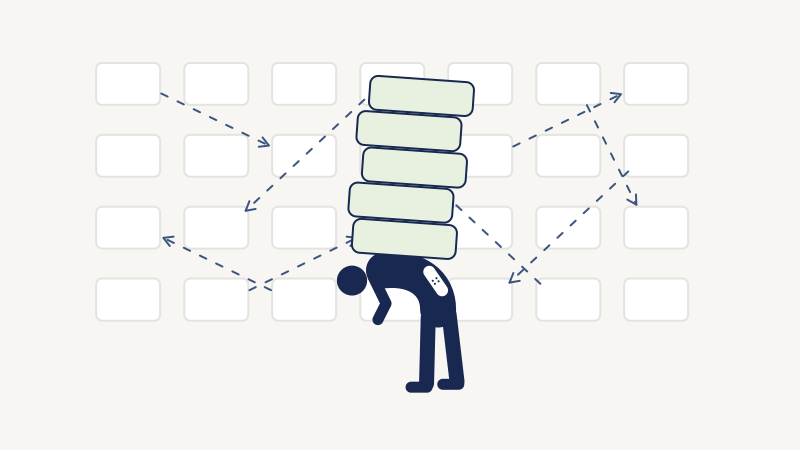
The catch only shows when you look at the whole organization instead of a single team. A company does not work on one thing but on many value streams at once. Slice each of them into segments and you get a multi-project landscape in which nobody sees the whole any more. But because the whole still has to fit together, a second apparatus grows: coordination meetings, status reports, coordination roles, handovers. It tries desperately to produce what the cut has just severed.
In such organizations, everyone ends up overloaded without anyone working too little. Capacity simply no longer flows into value creation but into understanding who is currently doing what and why. And because not all slices are equally important at the same time, the gaps in the others get filled with additional initiatives. The result is constant jumping between unconnected tasks, and precisely this jumping is one of the biggest drivers of cognitive load. Narrowing therefore does not lower the load. It shifts and multiplies it.
Why less context is no relief
Peter Kruse described why this reflex is not just ineffective but expensive. A merely complicated system can be simplified by decomposition. A complex system is destroyed by it, because you cut exactly the interactions from which adaptability arises.
His answer to complexity runs counter to everything that promises relief. Creativity, according to Kruse, cannot be forced. Real insight arises from the „Konfrontation von einzelnem Gehirn mit Komplexität" (the confrontation of an individual brain with complexity) until someone understands a pattern forming. And the only lever the individual holds in this is remarkable: to „mit Information überfordern, viel zu viel davon, den Kontext erweitern ohne Ende" (overwhelm oneself with information, far too much of it, expanding the context without end). It is not sealing oneself off that produces innovation, but deliberately exposing oneself to more complexity than is comfortable.
This holds the decisive point for the design of work. Complexity can only be reduced without loss if you know the overall context and recognize patterns within it. Whoever sees only their slice cannot simplify meaningfully at all. They can only leave things out and hope it was the right thing. The overall context is therefore not a burden to be organized away, but the precondition for the load becoming manageable in the first place.
Harmful load and productive tension
This invites a misunderstanding that I want to clear up unequivocally. This is not about relieving people by lowering the bar.
Both ends of the scale do harm. Robert Sapolsky describes in "Behave" (2017) how chronic stress weakens the prefrontal cortex, which is responsible for weighing options and considered decisions, while at the same time amplifying the reflexive reactions of the amygdala. Under permanent stress, people no longer have their full potential at their disposal. At the other end lies under-challenge, which leads to boredom and quiet quitting, the extent of which Gallup's engagement studies have documented for years.
In between lies the zone that Mihály Csikszentmihalyi described as flow: high demand meeting high skill. That is precisely productive tension, and it is not a problem but the goal. The Job Demands-Resources model by Arnold Bakker and Evangelia Demerouti (2007) makes the condition for it visible. Demands cost energy, resources provide it. And what counts as a resource in this model is revealing: autonomy, social support, feedback, development opportunities, meaning. High demands do not lead into exhaustion. They only do so when the structure withholds the resources that make them bearable.
From this follow two levers, not one. You can lower the demand. But you can equally strengthen the skill so that a person is equal to a high demand and meets it in flow rather than in fear. The second lever is almost always overlooked, although it is the only one that lets people grow.
Where the answer actually lies
If the cause lies in how work is cut, then the answer lies in organizational design. That is the royal road, and it is less spectacular than it sounds: teams that carry responsibility for a whole rather than for a component. Fewer parallel initiatives, so that people can stay with one thing. A shared language that lowers the effort of translating. Proximity to those who use the result, so that guesswork and rework disappear. All of these levers lower the avoidable load, meaning fragmentation and the effort of understanding, and leave the overall context untouched.
And with that, back to the meeting with the two numbers. An offer to individuals is not problematic because it arrives at the wrong place. It arrives at exactly the right people. It becomes problematic when it remains the only answer. Because then an organization shifts responsibility for the exhaustion onto the exhausted. Take better care of yourselves, is the message, while the conditions that exhaust you remain unchanged.
When the meeting was over, I picked up the question again, this time with the managers of the affected units and together with the colleagues from HR. Because that is where these numbers land first. HR sees the exhaustion earlier than anyone else and responds with what lies in its own toolbox: offers for people. That is not convenience but a question of access. HR does not decide how work is cut. This diagnosis therefore only takes hold if it is not handed over as a result but worked on together: HR brings in the data and the picture of the strain, the managers bring access to structure and priorities. Only together does an answer at the right level emerge.
The good news, whether you carry leadership responsibility or put the numbers on the table: you sit at the lever that works. Not the big one that rebuilds an organization overnight, but the many small decisions about how work is cut, how many initiatives run at the same time, and how much overall context a team is allowed to keep. You cannot train burnout away. But you can change the conditions that produce it. That is harder than an app license. It is also the only thing that helps.
The receiver's side of leadership is one of the building blocks of our book "Angewandte Kollaborative Führung" (Applied Collaborative Leadership), which is currently in the making. If you do not want to miss the publication:
Subscribe to the newsletter- Maslach, C. & Leiter, M. P. (1997): The Truth About Burnout. How Organizations Cause Personal Stress and What to Do About It. Jossey-Bass.
- Kruse, P.: Wie reagieren Menschen auf wachsende Komplexität? Video interview (German).
- Sapolsky, R. M. (2017): Behave. The Biology of Humans at Our Best and Worst. Penguin Press.
- Csikszentmihalyi, M. (1990): Flow. The Psychology of Optimal Experience. Harper & Row.
- Bakker, A. B. & Demerouti, E. (2007): The Job Demands-Resources Model: State of the Art. Journal of Managerial Psychology 22(3), 309-328.
- Tregubov, A., Boehm, B., Rodchenko, N. & Lane, J. A. (2017): Impact of Task Switching and Work Interruptions on Software Development Processes.
- De Smet, J. & Grgić, V. (2024): Navigating the Complexity of Cognitive Load in Software Product Development.